Search This Blog

Showing posts with label science. Show all posts

Monday, February 21, 2022

On Human Evolution

This post is brought to you buy the anti-science, anti-intellectualism movement that continues to exist in today's world; specifically, the anti-evolution movement that fails to understand evolution in any capacity.

More specifically, it is brought by the comment that spawned this TikTok video by @science_is_real.


    I saw this a few days ago and the mathematics have been plaguing me since. Why? Because this is an example which can be converted into a path that can be followed.

There has been a lot of research into the correlation between spleen size and ability to do longer, deeper dives in humans: fro reference: https://www.ncbi.nlm.nih.gov/pmc/articles/PMC3376424/
And even to causality of spleen size variance during breath-holding experiments: https://journals.plos.org/plosone/article?id=10.1371/journal.pone.0068670 (this study only had 12 participants so it may not be entirely representative of the overall human population).
Interestingly, the spleen size has a wide variance in the human population and, unlike the other organs, is very malleable; it changes in response to, well, everything. 

The malleable nature of the spleen makes it difficult to clearly and absolutely analyze; difficult, but not impossible. 

This is the point where I remind you that I'm no one special. I am merely inquisitive and like answers. I like data. I like seeing how the world works.

So, for a hypothetical examination of how the divers outlined in the video have been evolving we have to start with a hypothetical starting point. Let us say that there were 2,500 individuals as part of a nomad tribe. When they decided to settle into their lives of huts built on stilts they were no different from the average human population. So their spleens would have had the wide variance of 93 to 253 mL in volume as a resting, healthy, size. Furthermore, during the breath-holding experiments the variance in size was recorded spanning a range of 7% to 20% in spleen volume reduction. 

Despite the small sample size of the study we can still use these numbers as a baseline for a crude model that can show how populations change over time. We have two variables to track: resting size and contraction during breath holding. Because the mechanism of longer divers seems to be that their spleens release red blood cells into the blood during the breath holding I will presume that the larger contractibility of the spleen correlates to better survival rates during long dives.

Now, let's presume that the figures mentioned above are our 1 standard deviation posts, meaning that 2/3 the population will have their normal function within those ranges for both sets. 95% of the population will within twice the range (this is a guess since I don't have an actual standard deviation to work with) and only extraordinarily great or poor spleen performances will be outside those ranges at a rate of 2.5% of the population each.

Free Diving, as a sport, has an absurdly high death rate (as in, it's so high why would anyone do it?) of 1 in 500 dives among the recreational population. At expert levels, which the current peoples of aquatic cultures would certainly rival, the rate is reduced to 1 in 50,000 dives due to the extensive levels of safeguards in place at competitions ( https://freedivingfreedom.com/risks-of-freediving/freediving-death-rates-the-shocking-reality/ ).

As tempting as it is to say that the original stilt-house divers would have the same death rate as today's recreational freedivers we cannot denigrate them to that level. It would have caused them to go extinct quickly if the entire population were dying at a rate of 1 death per 500 dives whilst diving several times a day each. So quickly, in fact, that they would suffer 4x the number of diving deaths as they have people if they only dove 5x a day - keeping in mind that each free dive is ONE breath.

I will, instead, give a blanket rate of 30% deaths per generation due to diving accidents and presume that a reasonable percentage of the population dies per generation due to unrelated causes (50% is what I am using for the remaining mathematics as a 50% death rate over the course of 20 years seems reasonable through age, accidents, and disease in a culture that is not readily prepared with modern safety equipment and medicine). Couple it with a growth rate of 110% and there are more babies made per generation than there are deaths, so the community grows.

The 50% death rate really has no direct impact on the specific mutation of spleen enlargement that we are looking to follow so we can discount it completely when it comes to the genetics involved, but it has to be considered for overall population size. Which means that, among the 30% who died in dive deaths, we can presume that the majority of them died due to their inability to perform the dive tasks and that that is a direct result of their spleen size and lung capacity. Therefore, their removal from the gene pool will remove those at the bottom of the spleen functionality end of the gene pool before they can generate many offspring.

From these assumptions we have the following crude simulated population growth:
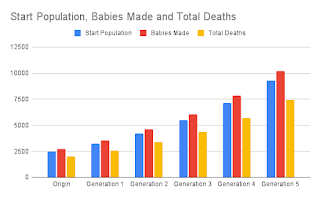


If Natural Selection were not at work on this population through the adversity of the constant free diving then the spleen size among the population wouldn't be altered but, because that excessive stress on the population exists we can see how it affects portions of the population differently.

The model presumes that the worst 95% of the small-spleen crowd die each generation from dive-related injuries with 95% of remainder of those deaths coming from those who have average spleens. As you can see it only takes a single generation to wipe those with smaller spleens off the population chart.
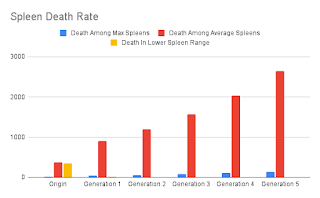

Which leads to a different population breakdown as early as the first generation of people born in to the environment.
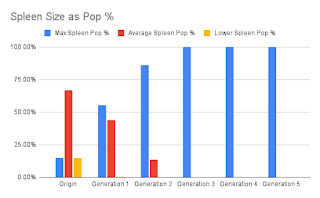


What fascinated me the most about this is how quickly such an adverse condition can dramatically change a population. 
I expected, when I set out to make this model, that it would take at least 500 years (25 generations) to show any significant change to the population and I am quite surprised that it only took two generations to eradicate the smaller spleens from the group with a fatality rate that is less than 10% that of the recreational free diving death rate among the world today. 

While "what doesn't kill you makes you stronger" is really not applicable to individuals, it certainly is to populations.

Isolation plus adversity drives Natural Selection and, in turn, evolution. 


Monday, March 2, 2020

Immunology and anti-vaxxers

I'm not a molecular biologist. I'm not an immunologist. I'm not a doctor. I'm not a pathologist. I'm not a lot of things relevant to the study of virology and how diseases work.

What I am, though, is inquisitive. I am logical. I reason.

AND I PAID ATTENTION IN SCIENCE CLASS.

The anti-vax movement disapproves of the removal of religious and philosophical exemptions from vaccinations within the state. Some people are against it on the grounds of government overreach but nearly all of them don't really understand how vaccines work nor do they understand their importance.

I encounter these people a lot in my internet meanderings.

Here is a summary of a recent conversation with one of them; I have been told by several people who are fancy-pants biology people who have degrees I can never attain that the below is a reasonable summary of an entire semester of college immunology.

------

First off, they claim they are not anti-vax and they launched their counter with the age-old "if vaccines work then why are you so worried about this if you are vaccinated?" (this question comes in many forms). I find this a tiring argument because it shows the level of science ignorance of the person and they are always smug about it, thinking it is the super "gotcha" argument that proves vaccines are worthless.

-----

Let's have a crash course in this.

Mutations are the root of evolution. They are transcription errors in genetic information being copied during the reproductive process.

Mutations occur generationally, meaning that the change does not happen within a cell, but when a cell is replicating. In single-celled entities (like microbes) each division is a generation of the species, whereas within multi-cellular beings each cellular generation is of no significance to the overall species mutation rate, only gametes matter for multi-cellular beings.

Mutations can be one of three things: inert, beneficial, or detrimental (from the perspective of the organism that possesses the mutation). Inert mutations don't matter, they are just a difference; beneficial mutations help the organism survive; detrimental mutations limit the success of the organism.

Beneficial mutations succeed in reproduction faster than the others in microbes because each subsequent division is a whole generation and a whole opportunity to spread faster and farther.

Each host for a microbe population varies slightly. Each one provides slightly different conditions that favor or hinder the growth of a microbe. This is why different people experience different levels of illness when exposed to the exact same strains of a microbe. This is why treatments work in some people and are completely ineffective in others.

If microbes have no home then they have no opportunity to grow and thrive and... mutate.

When a population is 95% immune it is 95% impossible for a microbe population to even enter the situation and 95% impossible for it to spread.

Which such a spread limitation treatments can be much more focussed and effective because the resources are available to spend on eradication.

This is called herd immunity.

NOW we get into the answer to your question.

Herd immunity minimizes the spread of a disease by minimizing the number of hosts in which it can gain a foothold. It minimizes the number of differing environments that can each exert naturally selective forces on the disease. It limited the number of mutations that can happen to the strain of the microbe, limiting the net volume of variation and mutation that it can acquire.

THAT is why we are so worried about it despite vaccinations.

Because, if we dip too far below the 95% threshold, even as low as 90%, we open a sliver of our population up to becoming incubators and mutation factories.

We open up that sliver of the population to transport the microbes wherever they go and to spread it to the sliver of the population in those locations that are also not vaccinated.

Those differing geographic regions compound the level of environmental diversity created by different individual hosts and create even more diverse naturally selective forces to act upon on microbe population.

Now... let's do some real quick math here based on a bacterium that is well known, even if it doesn't have a ready vaccination for it because we have lots of ways of preventing sickness from it:
An e. coli bacteria has a generation of about 20 minutes. This means that if a single e. coli bacterium finds its way into a human host it doubles in number every 20 minutes. Each individual division is an opportunity for a mutation to occur.

Since the division is exponential this balloons up VERY quickly.
At the end of ONE DAY the number of e. coli cells in the host is an unmanageable number to type (2^720).
If those replications develop a more virulent, faster reproducing, or more lethal strain that is more successful in the host and able to spread to others then we have an outbreak that kills lots of people.
This happens. This is why we have e. coli scares even though simple hand washing and proper cooking techniques prevent the issue.

This same thing happens with EVERY disease. Vaccines work but they only work for existing strains and those similar enough to them for our body to recognize it. If a mutation happens that changes it just enough for our bodies' immune systems to no longer recognize it then EVERYONE, vaccinated or not, gets sick. The more infected hosts the more opportunities for such a mutation to happen; the more opportunities for such an infection to spread. The more opportunities for us to have created a new iteration of measles that we cannot treat with our current medications or which is just lethal enough to make treatments irrelevant altogether.

This, too, is happening. We have cultivated antibiotic-resistant strains of Staphylococcus (known as MRSA) which are now found in about 2% of the population; when it gets into their (or anyone else's) blood it becomes a lethal situation for more than 20% of the people infected.

The easiest and best, way to prevent massive disease outbreaks due to beneficial (to the microbe) mutations is to eliminate their ability to grow and thrive and reproduce and the easiest way to do that is.... TO VACCINATE EVERYONE

It might "just be wikipedia(1)" but it is well documented with primary sources in the bibliography at the bottom.


1. wikipedia has been, repeatedly, tested for accuracy against "real" encyclopedias and found to be more accurate AND have more detailed information (2). https://en.wikipedia.org/wiki/Herd_immunity
2. https://www.wired.com/story/wikipedia-online-encyclopedia-best-place-internet/

Monday, February 10, 2014

The Chambers Opened - fiction

Since the Sphinx was uncovered from the dessert it's purpose and secrets have been debated.

Tuesday, December 18, 2012

Global Climate Change

I think we're missing a lot of aspects of contributing factors because it is easy to fight over the two big arguments:
1 - whether it is man-MADE or not
2 - whether CO2 is the cause or not.

Sound is, essentially, the same as heat but at a MUCH lower frequency. Humanity makes a lot of noise. That HAS to have an effect.
Car engines, light bulbs, computers, etc all generate HEAT. It is an undeniable side-effect to what they do. That has to have an effect on things.
Furnaces generate heat. That is their core purpose. That has to affect things tremendously.

Our process of making CO2 generates a lot of HEAT and then traps that heat. It's not just the CO2 but all the things we do (per capita) multiplied by the number of people.

Also - the earth's natural equilibrium is for the northern sore of Canada to be a tropical rain forest. So says the paleontological evidence..... so on top of what we are doing the planet is still recovering from the last ice age to bring itself back to its normal.

In short - unless we figure out how to make the earth's equilibrium match OUR needs or figure out how to move underground / under the ocean - we're screwed on this planet.

200,000 years of human history is nothing next to the 80,000,000 that held the northern tropical rain forests and the 65,000,000 that held the tropical-temperatures around the globe before the impact prior to the Chicxulub impact... and all of the other epics prior to that one were also HUGELY larger than the time humanity has existed and all show the same thing - tropical temperature in the moderate and cold zones of this planet.

Is global climate change happening: yes, absolutely
Did we cause it? Nope.
Are we a contributing factor: certainly.
Are we a significant contributing factor: probably.
Do we ignore a lot of the ways we are contributing: this is as certain as the change itself.
Can we do anything about it: yes, but only if we, as a species, can accept the scientific truths about it and dedicate the resources to modeling ways to change the energy output of our industry and residences as well as figure out a way to properly sequester excess CO2 (secret: there are a lot of simple answers to the latter... some of them are even relatively easy to do).

For starters we need to accept that this is a very complex problem and stop outlining it as simple to the mass populace. We need to stop saying that we know, with certainty, that we CAUSED it. Many of the climate change naysayers are fighting back because they don;t believe humanity is so powerful that we could cause such a problem. Whether this view is ignorant of them or not we can stop their counter-arguments by eliminating the causation argument from the climate-change-is-happening camp.

From there we can focus our efforts on solar and wind technologies like several other "1st World" countries have done. Their usable lands for such energy sources are a fraction of the land available in the US for this and their capture rate is MUCH higher.

We could also engineer our buildings to support rooftop gardens and preserves to reduce the conversion rate of biological heat absorbers and carbon sinks into heat sinks that do not absorb carbon.
We could convert streets in cities into tunnels and cover the roofs of these tunnels with plant-supporting ground to do the same.
We could build buildings that allow for pockets of plants to grow on the sides of the buildings. This would provide additional insulation and further absorb carbon from the air.

These are just some things we could do to lessen our contributions to this problem.

Tuesday, September 4, 2012

Brain size and complex thoughts

I have been thinking a lot lately about self-awareness and other abstract brain functions as compared to the size on one's brain.

One thing that I find tremendously interesting is that people of differing head sizes don;t, necessarily, have intelligence that correlates to their brain size. The volume and shape of the cavity in their skull is not the determining factor in the overall ability for them to process information and make use of it.

Why then, do humans seem to be at the top of the intelligence scale?
What makes us so different if the differences in brain sizes amongst us are not the single-most deterministic variable for human intelligence?

Does this mean that other animals are smarter than humanity gives them credit for?

I think so.
For example I have several pets.

I have a dog:


and I have three ferrets:

(Yes, there are actually three of them in the same pouch)


There used to be four ferrets but this guy has moved on:


And I have a sugar glider:


And, for the sake of this discussion I will include a visitor of variable frequency who likes the free food in my kitchen in the winter:


Watching these animals on a daily (in some cases) basis makes me contemplate how much they think and understand their world. It makes me wonder how much they contemplate things. It makes me wonder what goes on in their heads.

I know, without any hesitation of uncertainty, that they think. I know that they are different. Each of the four ferrets above have (had) vastly different personalities. Each of them have very different behavioral patterns. Each of them differs greatly from any of the other animals shown on this page.

For example this guy:

understands the concept of confinement. He understands that he likes being out of his cage and he understands that he likes being in the playpen. He understands he likes space. He also understands the basic needs and that people are his caregivers.
I'm not sure; however, that he understands much more than that. He's not stupid, but he's not enticed by trying to do more with his life than play, sleep, eat and go potty.

This one, on the other hand, is different:

She, while being about two-thirds the size of the one above, is feisty. She understands the concept of confinement but, more importantly, she also understands the concept of freedom. She understands that a bigger pen is not the same as being free. She understands that freedom is not simply the opposite of confinement. She wants freedom.
She will systematically test the bars on their cage and she will systematically test every vertical post on their playpen. She will move around and around and around the play pen trying to find a means to climb out. She wants to explore and see "the world."
This one has no fear and no conception of boundaries. She has bitten the dog on the nose (his fault - he was harassing them in their playpen) and postured with an attitude that she would take him if he retaliated... and, he believed it.
This little ferret thinks and reasons. She bluffs and lies. She loves and snuggles. She is a complex being. Her "brother" is a simple animal that lives a simple life.


The other pets, the dog and the sugar glider, each have their own agendas. The dog understands freedom but, more importantly, loneliness and loyalty. He understands who his pack is and that we are more important to him than anything else. He also knows how to lie (all dogs do) and will gladly tell anyone and everyone that no one ever feeds him, that he never gets any love or attention and that he never gets to go for a walk. He also knows he is getting old. He may not know the concepts, but he knows the feelings. He knows that his medication makes him feel better. He knows that if he goes poop on a walk that I make us come back home via our dumpster but if he does not we can come right to the door. He knows that the four-lane road is VERY dangerous and the two-lane road is something to "stay out of." Some of this is conceptual and some of this is simple stimulus-response.
The sugar glider, by far the simplest of my pets, seems to be mostly a stimulus-response animal. The infrequent visitor, who fills the same evolutionary niche but through parallel tracks, and the sugar glider seem to have identical behavior patterns. Food, shelter, water, shelter, warmth. That is what they seek. Things that may threaten them cause them to seek shelter, things that do not threaten them probably will feed them.
My question is, and always will be - what is what? How much can a dog (or ferrets, etc) actually have "going on" in their minds with brains that are so much smaller than human brains?
I think the answer is clear: more than we realize.


I've discussed this with some other animal owners and with friends who are veterinarians (also animal owners) and the ideas vary widely on how much animals conceive and think.

Feel free to chime in on your own below.

Monday, November 29, 2010

Gravity

Gravity is an interesting thing and it is something I think about often.

The truth is simple: we have NO IDEA how gravity works.
We don't even know WHAT gravity IS.

Gravity appears to be a force generated by all matter, but WHY?
We understand magnetism.
We understand electricity.
We have NO IDEA on gravity (we also know nothing about the weak and strong nuclear forces).

Gravity is also anomalous in that it affects light the same way a glass lens does.... or does it?
We SEE that it does, but maybe the light doesn't experience any effect at all. Perhaps the space that light is traveling through is what it affected, making it LOOK like light is affected.

Then there's the question of Dark Matter.

80+% of the universe HAS to be some mysterious, non-interacting material that we refer to as "Dark Matter" for our current (very limited) understanding of the universe to work. This mysterious dark matter material is required to provide the gravitational force that allows for everything to form the way it has.... or does it? Is dark matter, perhaps, the force of gravity of parallel universes leaking into our universe? If so, does that mean that gravity is really a strong force but that is bleeds through universal barriers and, thus, is spread thin?

There are so many questions about this and the answers will amaze all of humankind when we figure them out.

I hope I can see what technological marvels these answers bring about.

Tuesday, November 9, 2010

I saw this the other day and it's REALLY weird.


It also makes this comic make sense:

http://www.dorktower.com/2010/11/05/dork-tower-friday-november-5-2010/


It also makes me wonder if time travel is possible and, if so, where are all of the time travelers (or the evidence of them having been here)?

Sunday, October 3, 2010

Agnosticism

I'm agnostic.
I find it amusing that some people seem to get VERY offended with that term.
I've had people tell me that calling myself agnostic is me being too afraid to say what I mean - that I should stand up for my beliefs and just admit to being atheist.
I've also had people try to tell me that that means I am going to hell.

Without delving into the whole topic of how foolish and hypocritical I find many people who decide to condemn my beliefs (that is a topic for another day and another post) I want to outline what, exactly, the term "agnostic" means  to many of the people that I know that use it.

It does NOT mean atheist.
It does NOT mean that we are anti-religion.
It does NOT mean that we condemn people who are religious.
It does NOT mean we condemn atheists.

It, essentially, means we are a scientist.

Many religious people find science threatening (note: I fully understand that there is probably a MUCH larger group of religious people who do NOT find science threatening - more on this topic someday in the future). This is something I completely and totally fail to understand. Science is not the enemy of anyone. Science is not a thing. Science is a process. That process is aimed at understanding the world around by observation and testing. Despite the assertions by those religious fundamentalists who are afraid of science: it is not a faith-based way of operating. Science is about the absence of faith. Science is about the need to have a preponderance of evidence to support an idea before it is accepted as fact.

That is why I am agnostic. I fail to have FAITH in anything.
I do not have faith that there is no god (that would make me an atheist).
I do not have faith that there is a single, all-powerful god (that would make me a mono-theist).
I do not have faith that there is a pantheon of gods struggling for the love and adoration of the people (that would make me a pagan).

I accept things as fact only when the preponderance of evidence shows me that I should. I accept that the sun will rise over the horizon tomorrow morning because the last several billions of years have shown evidence that it will. I accept that I will have air to breath tomorrow for the same reason. I accept that if I drink a glass of water it will help alleviate thirst.

I accept the world as I experience it.
I accept the scientific evidence for many things as it is compiled by the research of others.
I even accept the evidence that bad science is self defeating because others will come along and uncover it for what it is.
It may seem I have "faith" in things like evolution, or the existence of life on other planets, or the age of the Earth but, I assure you, it is not FAITH. It's science.
The Theory of Evolution can NEVER be proven unless someone has a means to travel MILLIONS of light years from where the Earth was millions of years ago AND has a powerful enough telescope to look at the animals on the ground AND has the means to record the life that it sees for the millions of year AND a means to play that back to us in time-lapse form. It's simply not going to happen. Because we cannot do that we cannot PROVE evolutions what led us to be here today: it will remain a full-blown theory for the remainder of humanity. But ALL of the scientific evidence points to it as a solid and well-developed explanation that works. The archeology, the anthropology, the current divergence of species, the biology, EVERYTHING. I accept evolution because ALL of the evidence points to it being a solid explanation.
Likewise, I accept the age of the Earth because the evidence points to it being MUCH older than the 6,000 years outlined in the bible.
I also accept that the idea that there is no other life in the universe is ridiculous (this does not mean I have faith it has been here). Anyone can test this one for themselves. Make a two column spreadsheet. Put in the following terms from the Drake equation:
1. The number of stars in our galaxy (raw number)
2. The percentage of star that have planets (a number between 0 and 1 - perhaps .25)
3. The average number of planets that can support life in a system with planets (in our system this is 1, our knowledge of exo-systems is limited. This will probably be significantly closer to 0).
4. The percentage of life-capable planets that actually develop life (given current locations of life I expect this to be close to 1).
5. The percentage of life-supporting planets that develop intelligent life (between 0 and 1, probably very sloe to zero)
6. The fraction of planets who develop intelligent life that then develops a means to signal their existence (again, a number between 0 and 1, this one is probably in the middle)

Multiply these 6 factors together and you get the raw number of technological civilizations to have ever existed in our galaxy. There is an estimated 100 Billion stars in our galaxy. Assuming that only 1% of ALL stars have planets and that systems are approximately 8 planets per system with 2 out of 500 (our current knowledge) planets being able to support life and that 50% of those planets will develop life and that .01% of those planets will develop intelligent life and that 50% of intelligent life is able to develop technology that can signal its presence to the stars we have 3200 civilizations existing in our galaxy.

There are ways to refine this equation… but this was a post about being agnostic, not a post about alien life but the numbers don't lie :-)